

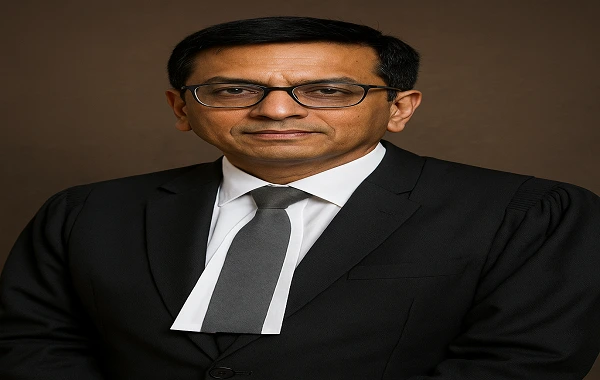
Justice D.Y. Chandrachud: Redefining India’s Judiciary with Vision and Reform
In a democratic nation like India, the judiciary stands as a powerful pillar of governance, guarding constitutional values, safeguarding civil liberties, and delivering justice to all. At the helm of this institution sits the Chief Justice of India, a position of immense responsibility and influence. Among those who’ve recently held this esteemed office, Dr. Dhananjaya Yeshwant Chandrachud, the 50th Chief Justice of India, has emerged as a beacon of modern legal thinking, human-centered justice, and digital reform.
Since taking office on November 9, 2022, Justice Chandrachud has become a household name, celebrated for his landmark verdicts, inclusive leadership, and push toward a tech-savvy, transparent judiciary.
Early Life and Education: A Legacy of Legal Excellence
Born on November 11, 1959, in Mumbai, D.Y. Chandrachud grew up in a family deeply rooted in law. His father, Justice Y.V. Chandrachud, served as the 16th Chief Justice of India, holding the position for a record-breaking seven years (1978–1985).
Justice Chandrachud’s academic journey reflects both diversity and distinction. He earned a degree in Economics from St. Stephen’s College, Delhi, followed by an LLB from Delhi University. His pursuit of legal excellence continued overseas with an LL.M. and Doctor of Juridical Sciences (S.J.D.) from Harvard Law School, where his academic work earned international recognition.
These early exposures — both Indian and global — have shaped his jurisprudence into one that honors constitutional values while embracing international best practices.
Professional Journey: From Advocate to Chief Justice
Practicing Advocate and Government Counsel
Before donning the judicial robe, Chandrachud had an impressive legal career. He practiced law in the Supreme Court of India and the Bombay High Court. Between 1998 and 2000, he served as Additional Solicitor General of India, representing the government in several high-profile constitutional and commercial matters.
Judge of the Bombay High Court
In March 2000, he was appointed as a Judge of the Bombay High Court, where he served for over 13 years. Known for his clarity, fairness, and progressive decisions, he handled diverse civil, criminal, and constitutional cases with a balanced and human-centric approach.
Chief Justice of Allahabad High Court
His elevation in 2013 as the Chief Justice of the Allahabad High Court brought fresh reforms. He pioneered digitization, streamlined record-keeping, and promoted faster case disposal — initiatives that were widely praised by both the bar and the bench.
Supreme Court Justice
In May 2016, Justice Chandrachud ascended to the Supreme Court of India. Since then, he has authored and contributed to several landmark rulings that reflect his unwavering commitment to constitutional morality, inclusion, and accountability.
Landmark Judgments: Justice Rooted in Rights
Justice Chandrachud is widely known for his liberal, empathetic, and reformist interpretations of the Constitution. Below are a few milestone judgments:
1. Right to Privacy (2017)
Part of a nine-judge bench, he helped declare that the Right to Privacy is a fundamental right under Article 21. His opinion emphasized the deep connection between privacy, human dignity, and autonomy.
2. Decriminalization of Section 377 (2018)
Justice Chandrachud was part of the five-judge panel that decriminalized homosexuality in India, calling out discrimination against LGBTQ+ individuals and affirming their right to live with dignity.
3. Aadhaar Verdict Dissent (2018)
In a bold dissenting opinion, he raised serious concerns over the Aadhaar scheme, cautioning that it enabled mass surveillance and infringed upon civil liberties.
4. Sabarimala Temple Case (2018)
Justice Chandrachud supported the entry of women of all ages into the Sabarimala Temple, describing the practice of exclusion as unconstitutional and discriminatory.
5. COVID-19 Response (2020–21)
During the pandemic, he presided over critical benches that compelled the government to ensure oxygen supply, fair vaccine distribution, and the protection of migrant workers’ rights.
Reforms and Digital Transformation
As Chief Justice, he has taken concrete steps to modernize the judiciary and make justice delivery more accessible.
- E-SCR (e-Supreme Court Reports): Free digital access to all SC judgments.
- Live Streaming of Hearings: Ensures transparency by broadcasting constitutional bench proceedings.
- Gender Sensitization: Promoted gender-neutral language and behavior in court.
- Hybrid Hearings & Digital Infrastructure: Championed video conferencing and electronic filing systems to streamline court operations.
Leadership Style: Inclusive, Transparent, and Bold
Unlike many of his predecessors, Justice Chandrachud believes in direct public engagement. Whether through lectures, interviews, or courtroom demeanor, he brings a human face to the judiciary. He openly addresses sensitive topics like mental health, caste bias, and gender justice, reinforcing the idea that law must serve the people, not just in theory, but in practice.
Learn about California Senator Alex Padilla journey and key accomplishments. Dive into his legislative efforts and commitment.
Legacy and Long-Term Impact of Justice Chandrachud
Justice D.Y. Chandrachud’s tenure isn’t just about passing judgments — it’s about transforming systems. His legacy will be remembered for making the Indian judiciary more people-centric, digitally empowered, and socially aware.
In a time when the gap between legal institutions and the public often seems wide, his leadership has helped bridge that divide with empathy, reform, and foresight.
Conclusion
Chief Justice D.Y. Chandrachud embodies the spirit of a modern Indian judiciary, rooted in tradition but unafraid to embrace reform. His pathbreaking verdicts, commitment to digital transparency, and advocacy for inclusive justice reflect a clear vision: a judiciary that works for the people, with the people. Whether it’s ensuring fundamental rights or ushering in systemic innovation, his leadership is shaping a more just and equitable future.
Frequently Asked Questions (FAQs)
Justice D.Y. Chandrachud is the 50th Chief Justice of India, appointed on November 9, 2022.
He is admired for landmark judgments on privacy, LGBTQ+ rights, women’s entry to temples, and digital reforms in the judiciary, all delivered with empathy and constitutional clarity.
He studied Economics at St. Stephen’s College, pursued law at Delhi University, and earned an LL.M. and S.J.D. from Harvard Law School.
Notable cases include Right to Privacy (2017), Section 377 decriminalization (2018), Aadhaar dissent (2018), and the Sabarimala verdict (2018).
Major reforms include e-access to judgments (E-SCR), live courtroom streaming, gender-sensitization protocols, and hybrid digital hearings.